Lead Flashing Repairs in Swindon: What Commonly Fails and What It Costs
Lead flashing is the metal sealing detail that sits at every junction between your roof and any vertical surface - the chimney, a wall, a dormer window. In Swindon's residential housing stock, which includes a significant proportion of post-war semi-detached and terrace housing alongside the Victorian and Edwardian streets of the Old Town area, lead flashings are near-universal. They're also one of the most common points of failure when a Swindon roof starts leaking. Research from the National Federation of Roofing Contractors shows that defective flashings account for approximately one in four domestic roof leaks across the UK - a proportion that feels consistent with the volume of Swindon roof survey findings where flashing failure is implicated. The town's climate contributes: Swindon sits in a rain shadow of the Cotswold escarpment, but still receives around 700mm of rainfall per year, and the temperature range between cold winters and warm summers creates the thermal cycling that fatigues lead over time.
Where Lead Flashing Fails on Swindon Roofs
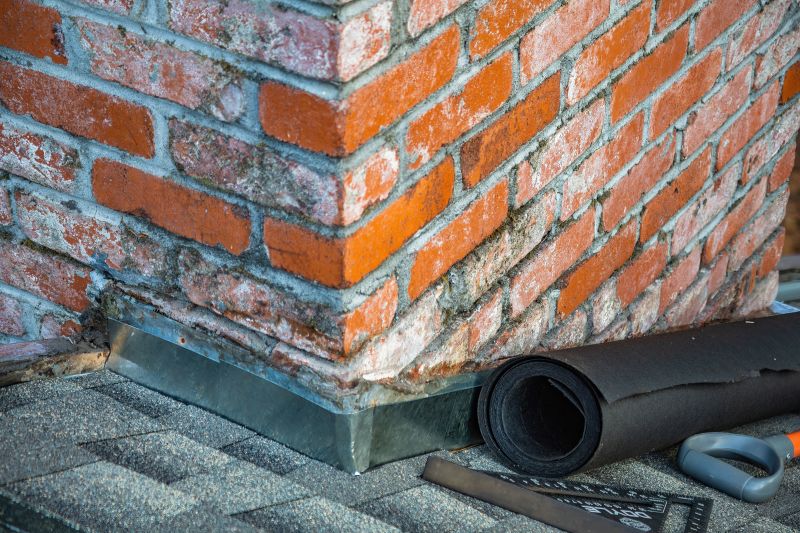
Lead is found at several specific locations on a typical Swindon residential property.
Chimney flashings are the most complex set - step flashings on both sides, a back gutter at the high side, and a front apron at the low side. All four elements experience different stress from water flow and thermal movement, and they can fail independently. Chimney flashings are the most common source of leak calls in Swindon's older housing stock.
Abutment flashings run where a roof slope meets a wall, such as at the junction of a rear extension with the main house. Swindon's proliferation of 1960s-1980s housing extensions makes this a very common location for lead failure, particularly on thin code 3 lead that was standard during this period.
Valleys are high-stress locations where two roof slopes meet. Water concentrates there, so valley lead needs to be correctly specified (code 5 is the current standard) and wide enough to contain the flow at the valley bottom.
Dormer flashings wrap around the cheeks and head of a dormer window. A common location for both condensation-related problems and direct water ingress when the lead has pulled away.
Roof Repairs Swindon handles lead flashing repairs and replacement across Swindon and the surrounding Wiltshire area.
How Lead Flashing Fails - The Mechanics
Understanding why lead fails helps explain what repair approaches are appropriate.
Thermal fatigue is the most common cause. Lead expands significantly in summer and contracts in winter. A flashing fixed rigidly at intervals that prevent this natural movement will crack at the fixed points over time. This is one reason old-fashioned mortar pointing into the chase joint fails: the mortar is rigid; the lead needs to move.
Detachment from the mortar chase is the other main mechanism. Lead step and abutment flashings are fixed into the mortar joints of adjacent brickwork. Over time, that mortar deteriorates, the lead pulls away, and rain enters behind it - often visible as dark staining on the brickwork or render adjacent to the roof junction.
Thin gauge specification is a factor on a lot of Swindon's 1960s-1980s housing stock. Lead is rated by code number - code 3 is thin, code 5 is the current standard. Code 3 lead is more prone to thermal cracking and has a shorter lifespan. Poorly joined overlapping sections are a separate failure mode - lead-lock clips, lead welding, or correct lap dimensions are all needed to keep the joints watertight.
Diagnosing Lead Flashing Problems in Swindon
The internal signs of lead flashing failure in a Swindon property are typically damp patches on walls or ceilings close to the failed location. The key diagnostic feature is weather-dependence: damp that appears during or after rain (particularly driven rain from the south-west, which is Swindon's prevailing wet direction) and dries up in dry weather is almost certainly water ingress rather than condensation.
Damp near chimney breasts in upstairs rooms or in the loft is particularly associated with chimney flashing failure. We've looked at the wider picture of Swindon roof maintenance costs in our new roof cost guide for Swindon, which is useful context if the flashing failure is part of a broader assessment of whether repair or full replacement makes sense.
Lead Flashing Repair Options - What Works and What Doesn't
Strip sealant products (Flashband etc.) are sold at builders' merchants and marketed as DIY solutions for flashing problems. They provide a short-term waterproofing seal that typically lasts 3-7 years before the edges lift and water gets in again. They're a valid emergency stopgap but not a long-term repair, and they make subsequent proper lead work harder to specify correctly.
Re-dressing and re-pointing. Where the lead is in good condition but has pulled away from the mortar chase, it can be re-dressed (pressed back into position) and the mortar joint re-pointed. This is a genuine repair where the lead itself hasn't failed - it can extend the life of the installation by 10-20 years if the underlying lead is sound.
Section replacement. Cutting out a failed section and splicing in new lead. Appropriate where one element of a complex set has failed while the rest is sound.
Full replacement. The right approach when lead is old, thin, or has multiple failure points. New code 4 or code 5 lead, correctly specified and installed with appropriate lead-lock fixings and correct laps, should last 50+ years in Swindon conditions.
What Lead Flashing Repairs Cost in Swindon
Emergency strip sealant application (temporary): £100 - £200.
Re-dress and re-point at chimney or abutment: £200 - £450.
Replace chimney step flashings (both sides), new code 4 lead: £350 - £700.
Full chimney lead set (steps, back gutter, front apron): £550 - £1,100.
Abutment flashing replacement (per linear metre): £60 - £130 per metre.
Valley lead replacement (per linear metre, code 5): £75 - £160 per metre.
Scaffold for Swindon two-storey semi-detached: £500 - £900.
Scaffold is a significant element of the total cost for chimney and high-roof flashing work. Combining lead repairs with other roof work already scheduled - ridge tile repointing, tile replacement, guttering - in a single scaffold visit is substantially more cost-effective than separate visits.
FAQ
Q: How do I know if my Swindon roof is leaking from the lead flashing?
Damp patches on upper floor walls or ceilings that are weather-dependent (worse in rain, dry in dry periods) near a chimney, wall junction, or valley point strongly to flashing failure. A roofer can confirm with an inspection - often from scaffold, but sometimes via drone survey or binoculars from ground level.
Q: Is it worth repairing lead flashing or should I replace it on my Swindon property?
If the lead is in good condition but has just pulled away from its fixing, re-dressing and re-pointing extends its life significantly. If the lead is cracked, thinning, or original thin-gauge material from the 1960s-1980s, replacement with code 4-5 lead is the better long-term answer and costs less over the 50-year lifespan than repeated temporary repairs.
Q: Can I use a DIY sealant product on my Swindon lead flashing?
As a short-term emergency fix, yes. Flashband and similar products will stop the leak temporarily for 3-7 years. They don't address the underlying problem and make subsequent professional lead work slightly more complex (the old sealant needs to be removed). For a permanent fix, proper lead work is required.
Q: Why does combining flashing repair with other roof work save money in Swindon?
Scaffold is one of the largest cost components of high-roof work, typically £500-£900 for a Swindon semi-detached. If you're already having ridge tiles done, tiles replaced, or guttering work, having the lead flashings inspected and repaired in the same scaffold visit adds relatively little to the total cost. A separate scaffold visit for the flashings alone doubles that overhead.
Q: How long does new lead flashing last on a Swindon property?
Correctly specified code 4 or 5 lead, properly installed and fixed with lead-lock clips (not mortar-only fixing), lasts 50 years or more. Thin code 3 lead in locations with significant thermal movement may last only 20-30 years. The material specification at installation is the key variable.
Ready to work with Roof Repairs Swindon?
Let's connect! We’re here to help.
Send us a message and we’ll be in touch.
Or give us a call today at 01793 939231
Agency Contact Form
More Marketing Tips, Tricks & Tools